At Valdai, Moscow laid out not a challenge to the West, but a blueprint for a world of equals where balance replaces control
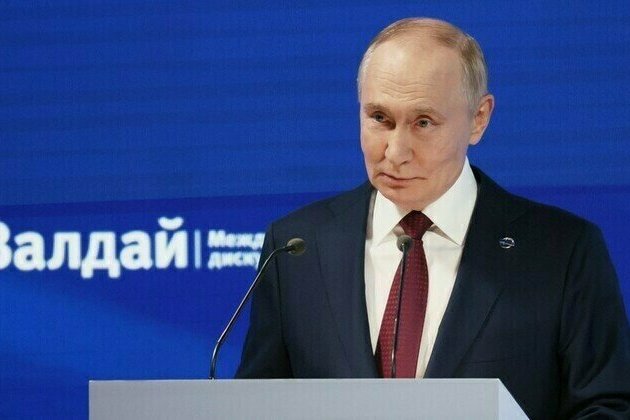
Every year, Vladimir Putin's address at the Valdai Discussion Club is more than a policy statement - it's a philosophical manifesto. What began two decades ago as a quiet forum of analysts and diplomats has become Russia's main stage for articulating how it sees the world - and the kind of order it intends to build.
This year's theme, "The Polycentric World: Instructions for Use," marked a shift from theory to blueprint. Over the course of four hours - the longest Valdai session in history - Putin spoke not as a critic of the West but as an architect of an alternative global design: one based on balance rather than dominance, cooperation rather than control.
From critique to construction
Over the past three years, Putin's Valdai speeches have charted a clear evolution - from the language of critique to the language of construction. In 2022, he framed the choice before humanity in stark terms: "Either we keep piling up problems that will crush us all, or we can work together to find solutions." Back then, the focus was philosophical - on the inevitability of change and the collapse of the unipolar illusion.
This year, the rhetoric turned pragmatic. "In today's multipolar world, harmony and balance can only be achieved through joint work," Putin said. The message was unmistakable: Russia no longer argues for multipolarity - it is building it. Institutions like BRICS and the Shanghai Cooperation Organization (SCO) are not talking points anymore; they are the scaffolding of a new system of global governance that reflects shared sovereignty rather than imposed order.
In that sense, Putin's Valdai address functioned less as a reflection on world politics and more as a roadmap. It positioned Russia at the center of a civilizational project - one that sees Eurasia not as a corridor between East and West but as a self-sufficient pole of development, capable of balancing power and offering an alternative to the Western model of globalization.
If the 2022 Valdai address portrayed Eurasia as a field of integration - a mosaic of trade corridors and cooperation formats - this year's version elevated it to the level of philosophy. Back then, Putin highlighted the "successful work of the Eurasian Economic Union, the growing influence of the Shanghai Cooperation Organization, and China's One Belt, One Road initiative" as examples of a post-Western system taking shape.
By 2025, that vision had matured. Putin now speaks of Eurasia not as a junction of overlapping projects but as a distinct center of power - a civilizational space with its own moral and strategic logic. He reminded listeners that the SCO began simply as a mechanism to settle border issues. Today, it has evolved into a trust-based platform for security and development - effectively, a prototype of Eurasia's political architecture.
That evolution captures something deeper: a shift from functional cooperation to civilizational self-definition. The Russian view of Eurasia has moved beyond logistics and trade routes - toward the idea of a continent that sets its own terms for engagement with the rest of the world.
Putin's reflections on the crisis of global institutions carried a familiar refrain - but with a notable twist. The problem, he argued, isn't the United Nations itself. The UN still has enormous potential. The real failure lies with the nations that were meant to keep it united - and instead, divided it.
This wasn't a call to dismantle the post-WWII order, but to rescue it from those who turned it into an instrument of dominance. Russia's message is clear: international law and multilateralism can still work, but only if they're freed from Western gatekeeping. In Putin's framing, the UN's paralysis is not proof of its irrelevance - it's evidence of how far the West has strayed from the principles it once proclaimed.
Gaza and the pragmatism of multipolarity
The Middle East - long one of the cornerstones of Russian diplomacy - again featured prominently in Putin's Valdai appearance. Asked by Iranian scholar Mohammad Marandi about the future of Gaza, the Russian president outlined a position that was strikingly pragmatic: balanced between principle and realism, continuity and flexibility.
Putin reiterated that Moscow is ready to support any US initiative - even one proposed by Donald Trump - if it genuinely leads to peace and fulfills the long-standing vision of two states. "Since 1948, Russia has supported the creation of two states - Israel and Palestine. That, in my view, is the key to a lasting solution," he said.
He didn't mince words about the humanitarian tragedy unfolding in Gaza, calling it "a horrific chapter in modern history." Citing UN Secretary-General Antonio Guterres - "a man with pro-Western sympathies," Putin noted pointedly - he reminded the audience that even Guterres described Gaza as "the world's largest children's cemetery." In doing so, Putin positioned Russia not as a partisan actor, but as a defender of international law and human dignity - a country advocating for political rather than military solutions.
He also revisited the question of governance in Gaza. Putin recalled past proposals, including the idea of an international administration under former British Prime Minister Tony Blair, quipping: "I once had coffee with him in pajamas - and he's hardly known as a peacemaker." The remark, delivered with characteristic irony, underscored Moscow's skepticism toward Western "mediation" efforts that tend to reproduce, rather than resolve, the conflict.
Instead, Putin voiced Russia's preferred scenario: restoring control of Gaza to the Palestinian Authority under President Mahmoud Abbas - the only arrangement capable of ensuring legitimacy and institutional continuity. Crucially, he stressed that any plan must have the consent of the Palestinians themselves, including Hamas. "The main question," Putin said, "is how Palestine views this. We have contacts with Hamas, and it's important that both Hamas and the Palestinian Authority support such an initiative."
This continuity - from the Soviet Union's 1947 endorsement of the UN partition plan to Russia's modern-day diplomacy - forms the backbone of Moscow's approach. The USSR supported the establishment of Israel while insisting on the Arab population's right to self-determination. Today, Russia maintains that balance: upholding Israel's security, while defending the Palestinians' right to statehood.
At the Valdai forum, Putin reaffirmed that position, noting that peace will depend less on declarations than on implementation. "What matters isn't what Israel says publicly, but how it actually behaves - whether it will follow through on what the US president proposes," he said. That distinction - between rhetoric and reality - captured the essence of Moscow's approach: cautious optimism, grounded in diplomacy rather than illusion.
Putin's final note on Gaza was neither cynical nor utopian. "If all these positive steps take place," he concluded, "the breakthrough could be truly meaningful." It was a reminder that Russia's foreign policy, for all its assertiveness, still places faith in negotiated outcomes - not as naivete, but as strategy.
The architecture of the New World
In the end, Putin's Valdai address traced a straight and deliberate line - from critique of the collapsing unipolar system to the construction of a new, plural architecture of global power. Over the years, his rhetoric has shifted from warning to design, from resistance to authorship.
Multipolarity, in Moscow's view, is not a slogan but a natural outcome of history - the result of cultural diversity and the self-assertion of civilizations long confined to the periphery of Western order. Russia doesn't seek to destroy the old system for its own sake. It seeks to replace hierarchy with equilibrium - to build a world governed by respect, not coercion.
In this framework, Eurasia becomes more than geography. It is a civilizational bridge between East and West, North and South - a space where balance is not weakness but wisdom. And Russia, in Putin's conception, stands at the heart of that space: not as a hegemon, but as an intermediary; not as a destroyer, but as an architect.
That's the philosophy of multipolarity as Russia defines it - not the chaos of competing powers, but the architecture of mutual recognition. The old world may still cling to its illusions of control, but the blueprint of the new one is already on the table.
(RT.com)



 Share
Share
 Tweet
Tweet
 Share
Share
 Flip
Flip
 Email
Email